Attractive Yield Backed by Real Assets and Cash Flows
Understanding Structured Credit
In our search for compelling risk-adjusted returns, Guggenheim Investments has found that structured credit is a sector in which we consistently find value over time. We believe the sector offers distinct advantages, including broad diversification across ratings, structures, and underlying assets. It has a demonstrated history of credit resilience, and has offered higher yields and spreads relative to comparably rated corporate bonds. As one would expect, there are also risks associated with structured credit that need to be managed.
As it is a common allocation of our total return portfolios, it is important for investors in our strategies to understand the complexities of the sector’s structure and potential risks and rewards. Asset-backed finance (ABF), the broadest category definition of structured credit, includes government- and Agency-backed securities, private real estate and other loans, as well as non-governmental tradeable securities that include asset-backed securities (ABS), collateralized loan obligations (CLOs), and residential and commercial mortgage-backed securities. These many variants of ABF generally follow the same process of pooling similar assets, tailoring a financing solution to suit the assets, and then issuing to investors the bonds or loans that fund the assets.
Structured Credit in Everyday Life
Discovering Yield in Structured Credit
While structured credit securities are not an apples-to-apples comparison to other fixed-income investments, we can compare their features as income producers. In such a comparison, investable yields for ABS have been significantly higher than similarly rated investment-grade corporate credit. The excess return is attributed in part to its complexity premium—the higher compensation an investor receives for the specific skills that are required to source, understand, properly analyze, and manage these complicated securities. The underlying premise is straightforward: Greater complexity warrants greater compensation.
As the chart below shows, A and AA-rated ABS outyield similarly rated corporate bonds, while one would have to go down in credit quality to BB-rated corporate bonds—the highest quality segment of the high yield market—to achieve a yield roughly equivalent to A-rated ABS. In our view, these relationships represent a compelling relative value proposition, even before adjusting for prospective defaults and losses. The shorter average life profile of various ABS subsectors also results in lower mark-to-market volatility for a given level of yield.
Structured Credit vs. Corporate Bonds
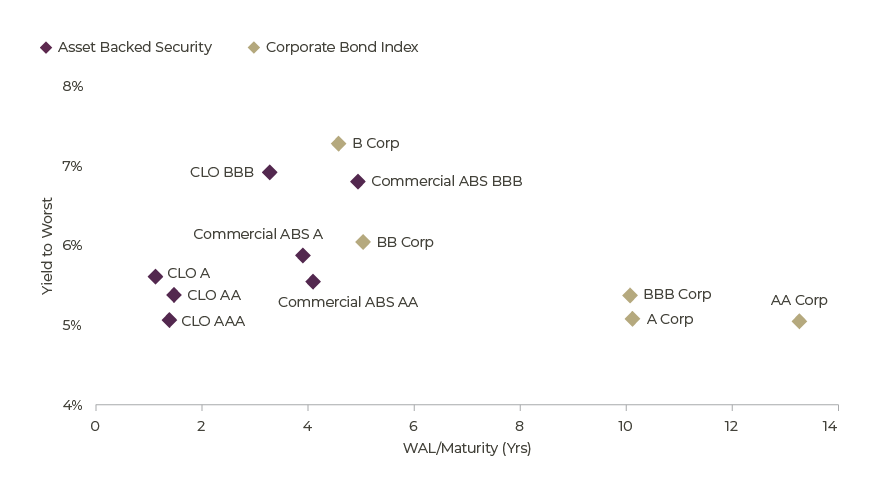
Past performance does not guarantee future results. Source: Guggenheim Investments, Bloomberg, ICE BofA Indices. This information is provided for informational purposes only and is intended to reflect the general characteristics of certain fixed income sectors in the recent market environment. The characteristics shown herein do not represent characteristics of any client portfolios and there is no guarantee that assets with similar characteristics will be available in the future. Corporate bond index data is based on the yield to worst (YTW) and maturities of the AA-, A-, BBB-, BB-, and B-rated sleeves of the Bloomberg U.S. Corporate Bond Index as of 6.30.2026. Collateralized loan obligation (CLO) data is based on the yield to worst (YTW) and weighted average life (WAL) of the Palmer Square CLO Debt Indices (AAA, AA, A, and BBB) as of 6.30.2026. CLO index yields assume that forward benchmark rates are realized. Commercial ABS information is derived from the aircraft, equipment, railcars, utility, and franchise subsectors of the ICE BofA AA-BBB U.S. Fixed Rate Asset Backed Index as of 6.30.2026, and does not include auto, consumer, student loans, timeshares, credit cards, or home equity subsectors. Weighting for the selected Commercial ABS universe is based on the current face value in index for the WAL and market value in index for YTW. The subsectors included in Commercial ABS are generally issued less frequently, backed by less familiar assets, and potentially higher yielding than those subsectors that are excluded. Because they are less common, they may be more susceptible to liquidity and valuation risk than other ABS subsectors.
Yields on Investment Grade ABS Are Typically Higher than Investment-Grade Corporates
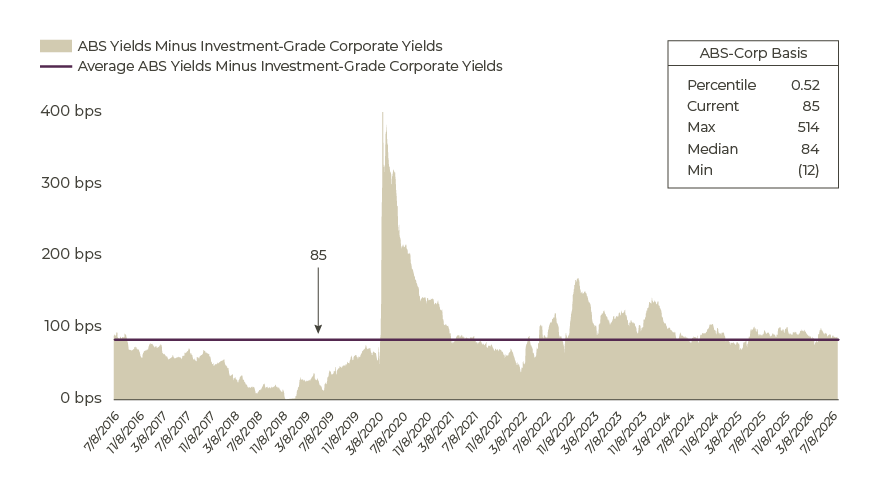
Source: Guggenheim Investments, Bloomberg. Data as of 7.8.2026.
How a Structured Credit Investment Is Created
In a process called securitization, an asset-backed bond begins with a simple agreement where one party agrees to pay another party. A family buys a home and agrees to make monthly mortgage payments. A manufacturing company borrows money to purchase a smaller competitor and agrees to the terms of a bank loan. A regional airline, looking to add routes, enters a lease agreement on a fleet of Airbus A320s. A franchisee opens a Wendy’s fast food restaurant in exchange for paying a percentage of sales to the brand’s parent company. Looking beyond the house, the manufacturing company, the airplanes, and the restaurant, these agreements are all contractual obligations to pay that form the basic building blocks of assets backing the securitization.
Securitization begins with the creation of a special purpose vehicle, or SPV. Think of an SPV as a company whose sole purpose is to buy assets with money sourced from debt (and equity) and secured by those assets. The SPV, also called the “issuer,” purchases a specific pool of assets and simultaneously issues debt securities—the asset-backed securities—and equity interests to fund the purchase of those assets. The pool of assets is typically of one type (auto loans, aircraft leases, corporate loans, etc.) but often is comprised of diverse and numerous “payers.”
Anatomy of an Asset-Backed Security
ABS may seem complex, but much of that complexity arises from embedded features that may potentially provide resilience. In this example, $100 of collateral assets produce $7.65 in interest income that pays $0.45 in SPV fees and $5.90 in coupon interest to ABS debt holders. If there is no trigger breach, the remaining $1.89 of excess spread is paid to the equity holders.
ABF deals carry features intended to help protect against loss and improve liquidity, including bankruptcy remoteness, prioritization of payments, overcollateralization, excess spread, amortization, professional servicing, and diversity of payers within each underlying pool.
Lenders, lessors, and specialty finance companies commonly turn to the ABF market for funding. Additionally, traditional corporate borrowers that receive payments under contracts may securitize those contracts as an alternative to issuing corporate debt, particularly when the contracts are of higher credit quality.
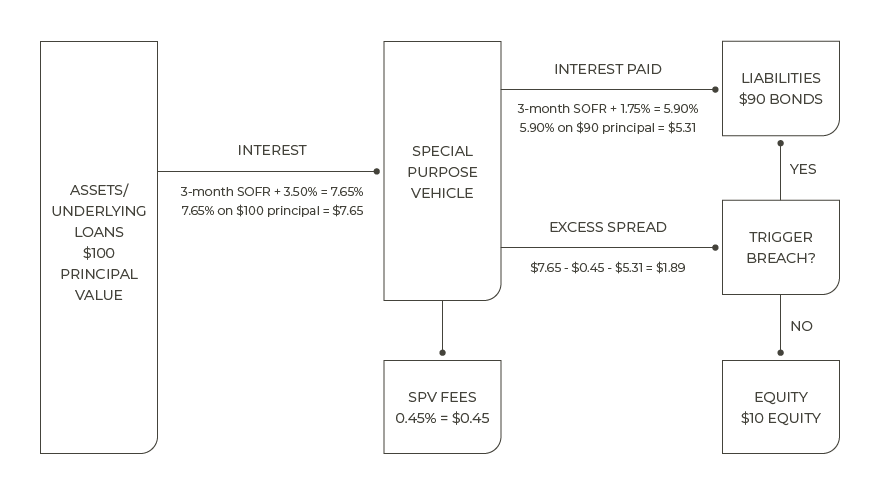
Hypothetical example for illustrative purposes only. Secured Overnight Financing Rate (SOFR) is a broad measure of the cost of borrowing cash overnight collateralized by Treasury securities.
Choosing Your Risk/Reward Profile
There are four principal avenues for generating return in active management of any fixed-income investment: Duration risk, where investors are compensated for the mark-to-market volatility and reinvestment exposure by going out to longer maturities in an upward-sloping yield curve; credit risk, where investors are compensated for the risk of not receiving principal and interest in a timely manner; convexity or call risk, exemplified by the mortgage borrower’s option to refinance when rates decline; and liquidity risk, which warrants a premium given that all portfolios face both external redemption pressures and internal rotation needs across segments of varying tradability.
Structured credit investments seek to customize these risks through layering of repayments, timing of repayment, and lien seniority on the collateral. This layering, or tranching, is achieved in a securitization through a set of rules defining the priority of payments—commonly referred to as a waterfall—that is the backbone of any securitization’s governing document. This tranching allows debt with diverse risk and reward characteristics to be created from a single pool of assets, with each tranche carrying a different credit rating based on the risk involved. The shorter maturity, higher rated tranches offer the lowest yields but carry the lowest risk of loss. The longer dated, more junior tranches have higher yields but carry lower ratings due to the lower cushion against loss. In this way, tranching serves to create debt that will suit different investor preferences.
Managing a Process for Capturing the Complexity Premium
Structured credit tends to reward firms that have built—and sustained—the institutional machinery to underwrite complexity. Robust corporate credit analysis and a mature legal infrastructure are not enhancements to a structured credit platform; they are preconditions for participating in it responsibly. We believe that managers that lack a fully resourced structured credit team, a parallel corporate credit function, dedicated legal counsel, and a disciplined portfolio construction group are structurally disadvantaged when assessing suitability, sizing exposures, and navigating documentation risk. Important factors are not merely overlooked in such settings, they are often invisible.
Our track record in structured credit reflects the depth and integration of our specialist teams across origination, credit, risk, trading, legal, and technology, bound together by a disciplined investment process. Structured credit has been a cornerstone of Guggenheim Investments’ fixed-income approach for more than two decades, underpinned by deep structural expertise and rigorous analytical capabilities that reflect a long-standing, firmwide commitment to the asset class. This enduring presence, in our view, materially constrains the ability of opportunistic entrants to generate consistent returns without assuming elevated volatility. We accordingly expect differentiation among managers to manifest over multi-year horizons rather than month to month — a reality that favors investors aligned with platforms built for the cycle rather than the moment.
The true differentiator, however, is not infrastructure alone but commercial awareness: a working understanding of counterparties, their motivations, and the economic rationale behind each transaction. This is a capability cultivated through decades of market presence and relationship continuity, not one that can be reconstructed from documentation after the fact. Commercial awareness is what enables our teams to identify inter-entity linkages that are not disclosed in offering materials but materially affect risk; assess adverse selection risk by understanding why a particular asset is being offered at a particular time by a particular sponsor; and calibrate pricing for risk with a view informed by both the structural mechanics of the security and the behavioral incentives of the parties involved.
These are the factors that extend beyond pitchbooks and cash flow models. They are, in our view, the factors that ultimately separate durable alpha from episodic outperformance, and justify a disciplined, long-horizon commitment to the asset class.
Frequently Asked Questions About Structured Credit
What is structured credit?
Structured credit, a form of asset-backed finance (ABF), includes tradeable securities such as asset-backed securities (ABS), collateralized loan obligations (CLOs), and residential and commercial mortgage-backed securities. These variants generally follow the same process: pooling similar assets, tailoring a financing solution to suit the assets, and issuing to investors the bonds or loans that fund the assets. Guggenheim Investments believes the sector offers broad diversification across ratings, structures, and underlying assets, a demonstrated history of credit resilience, and higher yields and spreads relative to comparably rated corporate bonds.
What types of assets back structured credit investments?
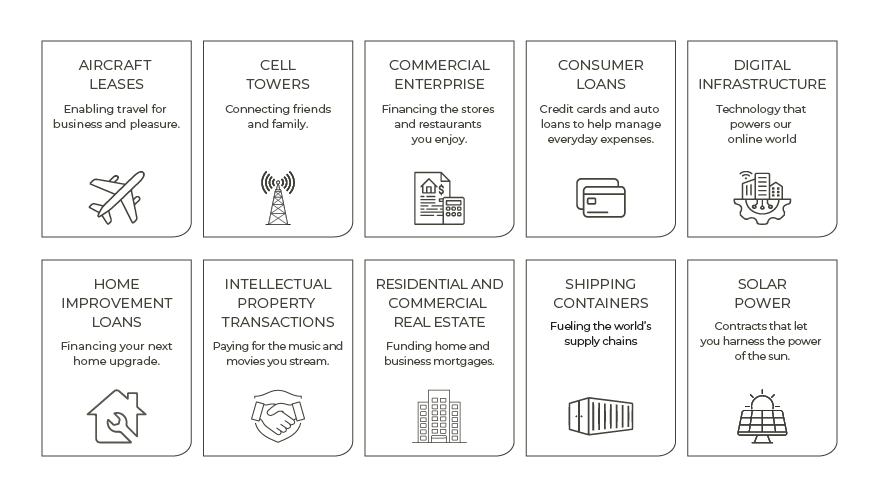
Structured credit is part of everyday life. Underlying assets include aircraft leases, cell towers, commercial enterprise loans, consumer loans such as credit cards and auto loans, digital infrastructure, home improvement loans, intellectual property transactions such as music and film royalties, residential and commercial real estate mortgages, shipping containers, and solar power.
Why has structured credit historically offered higher yields than corporate bonds?
Investable yields for ABS have historically been significantly higher than for similarly rated investment-grade corporate credit. The excess return is attributed in part to a complexity premium: the higher compensation an investor receives for the specific skills required to source, understand, properly analyze, and manage these complicated securities. Greater complexity warrants greater compensation.
How do ABS yields compare to investment-grade corporate bond yields?
A- and AA-rated ABS have historically provided higher yields than similarly rated corporate bonds. An investor would have to go down in credit quality to BB-rated corporate bonds, the highest-quality segment of the high yield market, tends to result in a lower yield roughly equivalent to A-rated ABS. The shorter average life of various ABS subsectors also results in lower mark-to-market volatility for a given level of yield.
How is a structured credit investment created through securitization?
Securitization begins with a contractual obligation to pay, such as a mortgage, bank loan, aircraft lease, or franchise agreement. A special purpose vehicle (SPV), also called the issuer, purchases a specific pool of these assets and simultaneously issues debt securities (the asset-backed securities) and equity interests to fund the purchase. The pool is typically of one asset type but often comprises diverse and numerous payers.
What is a special purpose vehicle (SPV)?
A special purpose vehicle, or SPV, can be thought of as a company whose sole purpose is to buy assets with money sourced from debt (and equity) and secured by those assets. In a securitization, the SPV is also called the issuer.
What features help to minimize and mitigate losses in asset-backed securities?
Much of the complexity of ABS comes from embedded features that may provide resilience. ABF deals carry features intended to help protect against loss and improve liquidity, including bankruptcy remoteness, prioritization of payments, overcollateralization, excess spread, amortization, professional servicing, and diversity of payers within each underlying pool.
What is tranching and the waterfall in structured credit?
Tranching is the layering of repayments, timing of repayment, and lien seniority on the collateral. It is achieved through a set of rules defining the priority of payments, commonly called a waterfall, which is the backbone of a securitization's governing document. Tranching creates debt with diverse risk and reward characteristics from a single pool of assets, with each tranche carrying a different credit rating. Shorter-maturity, higher-rated tranches offer the lowest yields and the lowest risk of loss. Longer-dated, more junior tranches have higher yields but lower ratings due to a smaller cushion against loss.
What does a manager need to capture the complexity premium in structured credit?
Structured credit tends to reward firms that have built and sustained the institutional machinery to underwrite complexity. Guggenheim Investments believes managers without a fully resourced structured credit team, a parallel corporate credit function, dedicated legal counsel, and a disciplined portfolio construction group are structurally disadvantaged. The true differentiator is commercial awareness: a working understanding of counterparties, their motivations, and the economic rationale behind each transaction.
What are the risks of investing in structured credit?
Investing involves risk, including the possible loss of principal. Structured credit, including ABS, mortgage-backed securities, and CLOs, consists of complex investments that may not be suitable for all investors. These securities are subject to additional risks, including credit risk, liquidity risk, and valuation risk. The value of a fixed-income security generally falls when interest rates rise.
This information is provided for informational and educational purposes only and should not be considered a recommendation of any particular security, strategy, or investment product. Please see Important Notices and Disclosures below.