For decades, investors seeking active fixed-income management were largely limited to institutional separate accounts or mutual funds. The rise of exchange-traded funds (ETFs) changed that calculus. Today, the fastest growing corner of the ETF market is actively managed strategies in a wrapper purpose-built for transparency, liquidity, and tax efficiency.
ETFs are pools of assets that combine the diversification benefits of mutual funds with the trading flexibility of publicly traded securities. ETF shares trade throughout the day on major exchanges, allowing investors to buy and sell shares through market hours.
As investors increasingly embrace their transparency, all-day trading capabilities, and potential tax efficiency, the ETF market has grown over six-fold from $2 trillion in 2014 to $13.5 trillion through March 2026, while the mutual fund market has grown from $11.9 trillion to $21.6 trillion.
The Rapid Expansion of ETFs
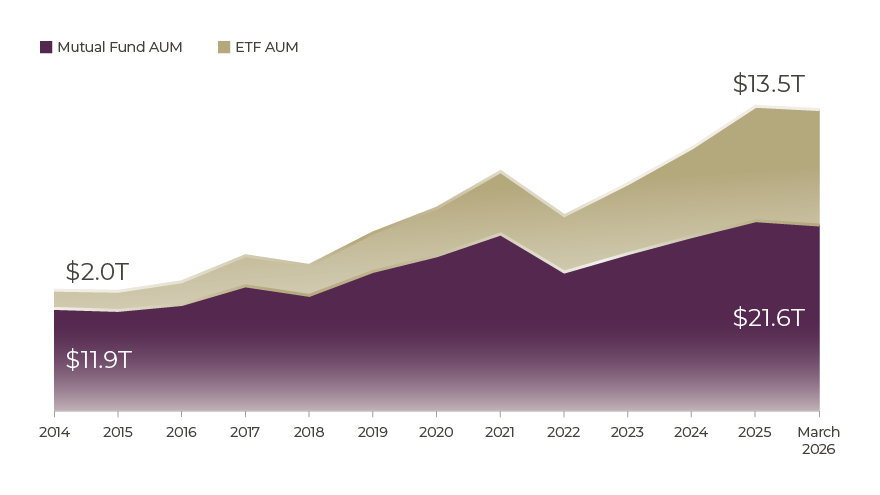
Source: Guggenheim Investments, Morningstar. Data as of 3.31.2026.
In the process, ETF market share versus mutual funds has more than doubled from 15 percent to 38 percent as they have expanded access to a wide range of investment strategies across bonds, stocks, and specialized markets. Today, ETFs are used not only for broad market exposure, but also for more targeted portfolio positioning, income generation, and risk management.
ETF Market Share Has More Than Doubled Since 2014
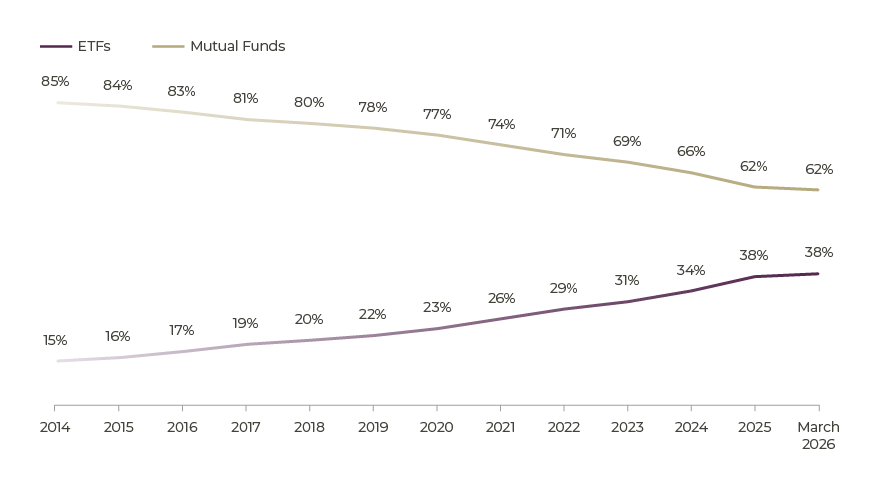
Source: Guggenheim Investments, Morningstar. Data as of 3.31.2026
The Rise of Active ETFs
A passive ETF seeks to replicate the performance of a specified index, meaning its portfolio composition is determined by the index’s rules, not by manager discretion. For most of their history—the first ETF launched in the United States was the SPDR S&P 500 ETF (SPY) in 1993—ETFs were synonymous with passively managed strategies.
That changed quickly. Sparked by 2019 Securities and Exchange Commission rule changes that made it easier to bring actively managed strategies to market in an ETF wrapper, active ETF assets have grown from nearly $50 billion in 2015 to more than $1.6 trillion as of March 2026.
Active ETFs Have Grown in Popularity
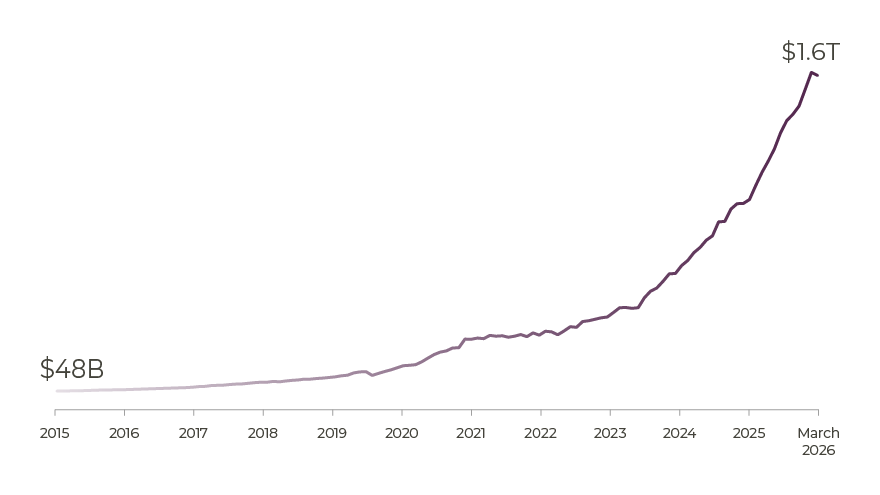
Source: Guggenheim Investments, Morningstar. Data as of 3.31.2026.
Actively managed ETFs, where portfolio managers select securities, adjust allocations, and manage risk in an attempt to outperform a benchmark or achieve a specific outcome, have eclipsed passive launches in recent years. Today, investors have gained access to a wide range of active approaches—spanning fixed income, equities, and specialized strategies— delivered with the transparency, trading flexibility, and tax efficiency that have made ETFs so popular. The result is a powerful combination: the judgment of a professional manager paired with the structural benefits of the ETF.
Active ETF Growth Is Outpacing Passive ETF Growth
ETF Year over Year AUM Growth
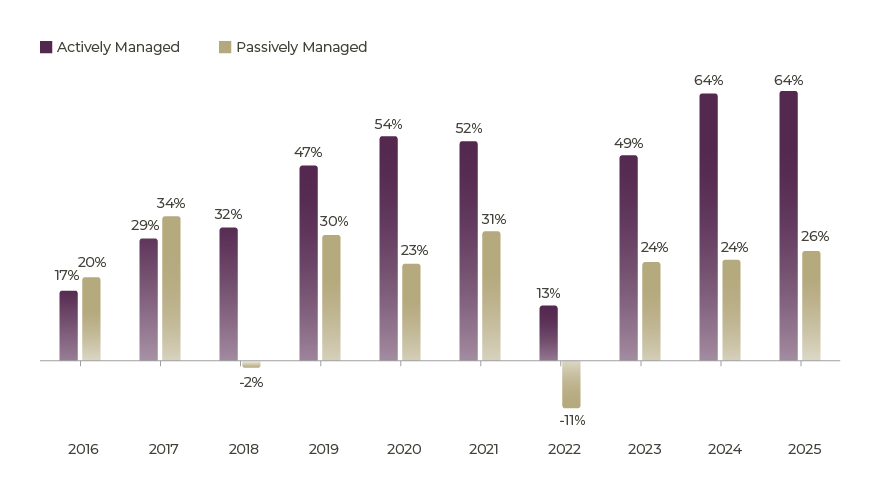
Source: Guggenheim Investments, Morningstar. Data as of 3.31.2026.
The ETF Wrapper Expands the Reach of Active Fixed-Income Management
The rise of active ETFs now makes active fixed-income management accessible in a structure that can align with client objectives—an important development given the distinct advantages active managers bring to bond portfolios.
Active vs. Passive in Equities and Fixed-Income
Trailing One-Year Total Return Percentile Rank of Index Within Respective Morningstar Category
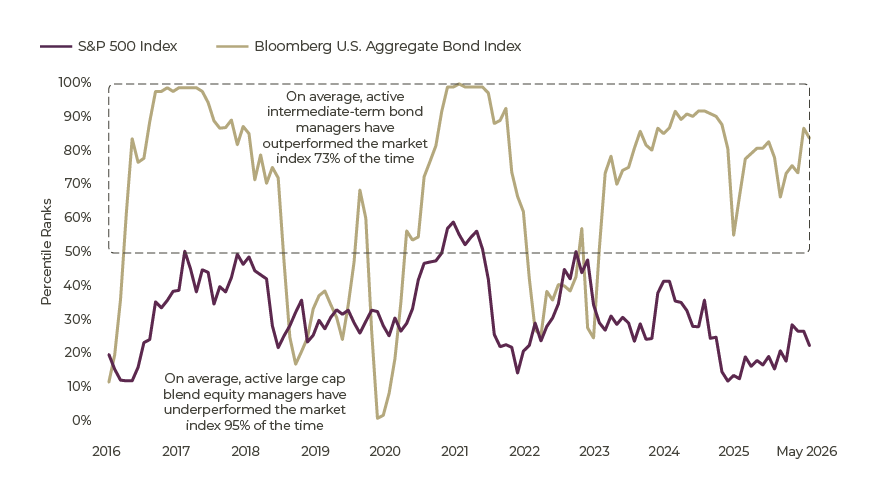
Source: Guggenheim Investments, Morningstar. Data as of 5.31.2026. Past performance does not guarantee future results. Based on institutional share class. S&P 500 is compared against actively managed funds in the Morningstar U.S. Fund Large Blend Category. Bloomberg U.S. Aggregate Bond Index is compared against a combination of actively managed funds in the Morningstar U.S. Fund Intermediate Core Bond and Morningstar U.S. Fund Intermediate Core-Plus Bond categories. Each line represents the one-year percentile performance ranking percentile of a respective benchmark relative to the funds in the aforementioned categories. The best performance ranking percentile is 1 percent, and the worst performance ranking percentile is 100 percent. If the benchmark’s performance ranking is below 50 percent, then the majority of funds underperformed the benchmark (bottom half). Conversely, if the benchmark’s performance is above 50 percent, then the majority of funds outperformed the benchmark (top half). See Methodology Note.
Methodology Note: The “73% of the time” and the “95% of the time” statements reflect the proportion of these annual observations in which the index ranked below the 50th percentile. This measure should not be interpreted as: (1) The percentage of active managers that outperformed the benchmark; (2) The probability that any individual active manager will outperform in the future; (3) A cumulative or annualized measure of active manager performance over the ten-year period; or (4) A risk-adjusted comparison.
Results based on cumulative multi-year returns, risk-adjusted returns, retail share class fees, or a survivorship-bias-adjusted universe may differ materially from the results shown. Past performance does not guarantee future results.
The peer universe used in the fixed income comparison combines Morningstar’s U.S. Fund Intermediate Core Bond and U.S. Fund Intermediate Core-Plus Bond categories. Core-Plus funds may invest in sectors that are not represented, or are underrepresented, in the Bloomberg U.S. Aggregate Bond Index, including high yield bonds, emerging market debt, and non-agency securitized credit. As a result, a portion of the observed outperformance versus the Index may reflect exposure to additional credit, sector, or liquidity risks not present in the benchmark, rather than active management skill. A comparison against a broader benchmark may produce different results.
The advantages of active management are especially evident in fixed income. The historical track record shows that for stocks, passive index-tracking vehicles have generally outperformed active managers. Over the past 10 years, the average active large-cap equity fund manager has underperformed the S&P 500 95 percent of the time. In contrast, over the same 10-year period, the average active intermediate-term bond fund manager has outperformed its benchmark, the Bloomberg U.S. Aggregate Bond Index (the Agg), 73 percent of the time.
The fixed-income market’s broader opportunity set is one reason active managers have outperformed passive benchmarks, but it is manager skill in identifying relative value and avoiding hidden risks within index weightings that delivers the real advantage.
Active managers can reposition portfolios as conditions evolve, such as managing duration through rate and yield curve shifts, adjusting credit exposure across the business cycle, and capitalizing on value-driven opportunities. Guggenheim Investments typically allocates to sectors underrepresented in the Agg that offer excess return potential—strategic positioning that is unavailable to passive vehicles by definition.
This emphasis on risk mitigation reflects the asymmetric return profile of bonds versus stocks. Equities offer meaningful upside when conditions are favorable, which passive strategies naturally capture. Bond returns, by contrast, are capped at coupon plus return of principal even in the best case, while credit deterioration can drive significant losses. The objective is therefore stable returns through avoiding defaults, not chasing upside.
Six Practices for Better ETF Execution
While ETFs trade like stocks, their execution dynamics are distinctly different. Achieving best execution requires an understanding of how ETF liquidity, pricing, and trading mechanics interact. The following tips highlight key considerations to help optimize trade outcomes and minimize implementation costs.
Set the maximum price you’ll pay or minimum you’ll accept — don’t let a fast-moving market fill you at a surprise price.
Why it matters: The easiest habit to adopt, and the most impactful.
Quoted prices can be wider at the open before all underlying securities trade, and at the close when volatility picks up.
Why it matters: Mid-day is typically when spreads are tightest.
The bid-ask spread — the gap between buyer and seller prices — is a better liquidity gauge than daily volume.
Why it matters: Many high-quality ETFs trade modest volume but have deep underlying liquidity. The spread tells the real story.
For best execution, orders above ~10,000 shares (or ~1% of average daily volume) should consider going through a capital markets or trading desk that can source block liquidity and work with Authorized Participants (the firms that create and redeem ETF shares).
Why it matters: Unlike with stocks, a large ETF order doesn’t have to “move the market.” The right desk often improves execution.
ETF market prices can trade slightly above (premium) or below (discount) the value of their underlying holdings especially in volatile markets.
Why it matters: A simple sanity check that helps avoid trading at a poor price.
Investors or their advisors can do a quick call with your broker’s capital markets specialist to sharpen timing, sizing, and order type on any non-routine trade.
Why it matters: Most execution missteps are preventable with one quick conversation.
The Six Practices for Better ETF Execution are provided for educational and informational purposes only. They are general guidelines regarding ETF trading mechanics and do not constitute a recommendation of any security, investment strategy, or transaction, and are not individualized investment advice. Appropriate execution practices vary based on the specific ETF, prevailing market conditions, and an investor’s individual circumstances. Investors should consult their financial professional before making any trading decision.
The Benefits of ETFs
ETFs’ emergence as a transformative innovation in modern asset management is derived in part from the combination of benefits they offer to individual and institutional investors. The expansion into active strategies and across asset classes has only helped increase their allure.
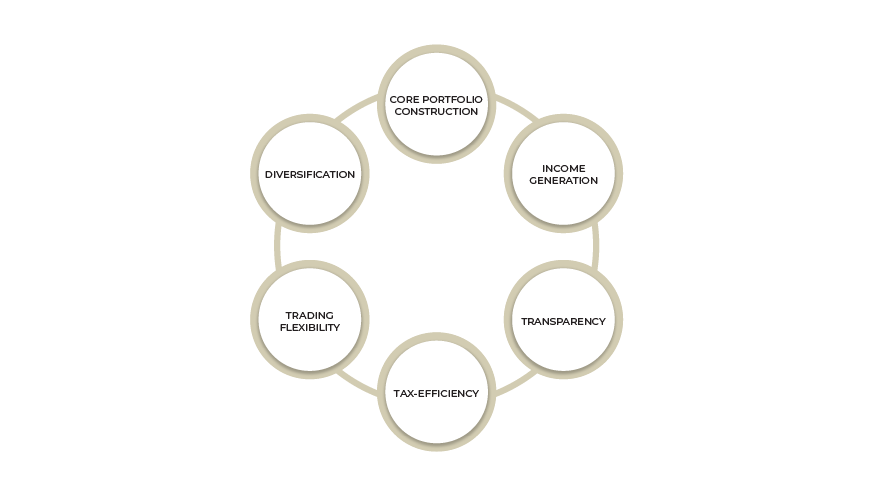
Core Portfolio Construction: Fixed-income ETFs can serve as a core component of a diversified portfolio by providing broad exposure to the bond market in a single investment.
Income Generation: Fixed-income ETFs seek to provide regular income through interest payments, helping investors meet cash flow needs many remain broadly diversified.
Transparency: Most ETFs disclose portfolio security holdings daily, giving investors a clear view of where their money is invested.
Tax Efficiency: Because most ETF shares trade on an exchange, ETFs generally do not need to sell securities to meet investor redemptions, helping reduce taxable capital gains distributions. The same in-kind mechanism can at times also be used when portfolio managers adjust holdings, though not in all cases, further limiting capital gains that would otherwise be passed through to shareholders.
Trading Flexibility: ETF shares trade throughout the day on major stock exchanges, providing continuous pricing and intraday liquidity.
Diversification: Like mutual funds, ETFs are professionally managed and can provide diversification across a broad range of asset classes, sectors, industries, and investment strategies.
Source: Guggenheim Investments. The tax treatment of ETF distributions depends on the nature of the income generated (e.g., interest income, capital gains) and the investor’s individual tax circumstances. A substantial portion of returns from fixed-income ETFs typically consists of interest income, which is generally taxed as ordinary income. Guggenheim Investments does not provide tax or legal advice. Investors should consult their tax or legal advisor.
Why Are ETFs Tax Efficient?
One of the key advantages of ETFs for investors is their potential tax efficiency, driven by the unique ETF share creation and redemption process.
In some other types of funds, investor redemptions may force the fund to sell securities to raise cash. If those securities have appreciated, the resulting capital gains will generally be distributed to the remaining shareholders, who could owe taxes on them even if they did not sell their own shares.
ETFs generally operate differently. Because most ETF shares are bought and sold by investors on an exchange, ETFs typically do not need to sell securities when investors buy or sell shares. When the investor places a sell order, their brokerage firm simply sells them in the secondary market, just like any listed stock.
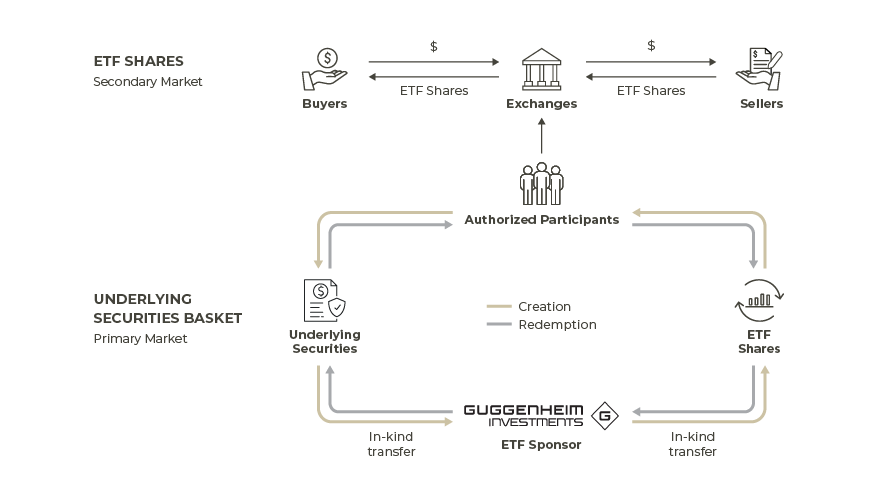
If market demand is insufficient, however, the brokerage firm may choose to redeem the shares through a large financial institution known as an Authorized Participant (AP). APs help create and redeem ETF shares by exchanging baskets of securities with the ETF issuer. When APs redeem ETF shares, they typically receive a basket of the underlying securities rather than cash, which they pass along to the investor’s brokerage firm, who sells them and transfers the cash to the investor. Because securities are transferred rather than sold, the ETF can often avoid triggering taxable gains inside the fund.
Imagine a mutual fund holding a bond that has tripled in value. When a large investor redeems, the fund sells the bond, which means every remaining shareholder receives a taxable capital gains distribution. With an ETF, that same redemption typically happens “in kind” instead of being converted to cash. The gain never gets triggered inside the fund.
Beyond redemptions, the in-kind mechanism also helps when the portfolio itself needs to change. When an ETF manager exits a position — for example, because a security has reached its price target or no longer fits the strategy — the appreciated shares can often be delivered in kind to an Authorized Participant as part of a redemption basket, rather than sold for cash on the open market. This allows many portfolio adjustments to occur without generating capital gains that would otherwise flow through to shareholders. This flexibility has limits, particularly for asset classes that are difficult to transfer in kind or for very large or rapid position changes, but it is a meaningful reason ETFs often distribute fewer capital gains than mutual funds with similar strategies.
As a result, ETF investors generally have more control over when they realize taxable gains—typically when they choose to sell their own shares, not when someone else does. Over time, this structural advantage may help investors keep more of their returns invested and compounding.
There is no guarantee that the mechanisms described above with reduce or minimize capital gains taxes. Tax treatment of ETF distributions depends on the nature of the income generated (e.g., interest income, capital gains) and the investor’s individual tax circumstances. A substantial portion of returns from fixed-income ETFs typically consists of interest income, which is generally taxed as ordinary income. Guggenheim Investments does not provide tax or legal advice. Investors should consult their tax or legal advisor.
The ETF Creation/Redemption Process Helps to Enable Tax Efficiency
Individual investors can buy and sell ETF shares on a stock exchange in the secondary market through a broker-dealer. Share prices fluctuate throughout the day based on supply and demand. If there is insufficient supply to meet a buy, or demand to meet a sell, an AP steps in via the primary market to transact directly with the ETF—either creating new ETF shares by delivering underlying securities to the ETF, or by redeeming ETF shares in exchange for underlying securities from the ETF. This mechanism keeps ETF share prices aligned with the underlying net asset value, or NAV. It also means the ETF share redemption does not cause a taxable event that would occur if the ETF had to sell securities.
Source: Congressional Research Service, Guggenheim Investments.
Premiums and Discounts
Shares of an ETF can trade at a price above or below its NAV—the per-share value of its underlying holdings. Small premiums and discounts appear regularly throughout the trading day and are a normal feature of how ETFs work. Behind the scenes, APs step in whenever the market price drifts too far from NAV, creating or redeeming shares to help bring the two back into alignment. This mechanism typically keeps any gaps small and short-lived.
Premiums or discounts can widen noticeably depending on market conditions or the liquidity of the underlying assets, but the relative movements between an ETF share price and its NAV provide investors with up-to-the-minute pricing information. In fixed-income ETFs, premiums and discounts behave somewhat differently than in equity ETFs, particularly in periods of stress when the underlying market is less liquid. This can be more pronounced for active fixed-income ETFs investing in credit markets, where the ETF pricing can provide real-time price discovery when underlying bonds may not be actively trading. Investors can see an ETF’s premium/discount history on the issuer’s website.
The Guggenheim Difference
Guggenheim Investments offers a focused lineup of active ETFs designed to deliver income.
An actively managed covered call options strategy targeting higher yields than traditional equity funds with reduced volatility.
View Fund Profile
An actively managed fund with broad exposure to securitized debt markets, including specialized subsectors where Guggenheim has deep expertise.
View Fund Profile
An actively managed multisector fund targeting high income and low volatility with a focus on liquidity.
View Fund Profile
An actively managed fund focused on AAA-A-rated broadly syndicated and middle market CLOs, with smaller exposure to commercial real estate CLOs.
View Fund Profile
We believe individual investors deserve more than a passive index approach — especially in today’s markets. Our active managers apply rigorous credit and risk analysis, aiming to protect capital during market stress while positioning to capture opportunities when they arise.
The ETF wrapper adds daily transparency, intraday liquidity, and tax efficiency. Combined with Guggenheim’s active management, that gives investors the best of both worlds: experienced judgment delivered through a modern, accessible vehicle.
Backed by deep expertise, robust research, and a time-tested investment process, Guggenheim’s ETFs are built to serve as durable portfolio building blocks—whether seeking broad market access, income, or a targeted strategic exposure.
Frequently Asked Questions About Active ETFs
What is an active ETF?
Actively managed ETFs are funds where portfolio managers select securities, adjust allocations, and manage risk in an attempt to outperform a benchmark or achieve a specific outcome. By contrast, a passive ETF seeks to replicate the performance of a specified index, meaning its portfolio composition is determined by the index's rules, not by manager discretion. Active ETFs combine the judgment of a professional manager with the structural benefits of the ETF: transparency, trading flexibility, and potential tax efficiency.
How fast have active ETFs grown?
Sparked by 2019 Securities and Exchange Commission rule changes that made it easier to bring actively managed strategies to market in an ETF wrapper, active ETF assets have grown from nearly $50 billion in 2015 to more than $1.6 trillion as of March 2026. Actively managed ETFs have eclipsed passive launches in recent years.
Source: Guggenheim Investments, Morningstar. Data as of 3.31.2026.
What is the difference between an ETF and a mutual fund?
ETFs are pools of assets that combine the diversification benefits of mutual funds with the trading flexibility of publicly traded securities. ETF shares trade throughout the day on major exchanges, while most ETFs disclose their holdings daily. ETFs also have a structural tax advantage: because most ETF shares trade on an exchange, ETFs generally do not need to sell securities to meet investor redemptions. ETF market share versus mutual funds has more than doubled from 15 percent in 2014 to 38 percent as of March 2026.
Source: Guggenheim Investments, Morningstar.
Do active bond managers outperform the index?
Over the past 10 years, the average active intermediate-term bond fund manager has outperformed its benchmark, the Bloomberg U.S. Aggregate Bond Index, 73 percent of the time, based on annual one-year percentile rankings. Over the same period, the average active large-cap equity fund manager underperformed the S&P 500 95 percent of the time. The fixed-income market's broader opportunity set is one reason, but manager skill in identifying relative value and avoiding hidden risks within index weightings delivers the real advantage.
This measure is not the percentage of active managers that outperformed or the probability of future outperformance. Past performance does not guarantee future results.
Source: Guggenheim Investments, Morningstar. Data as of 5.31.2026.
Why are ETFs tax efficient?
ETFs' potential tax efficiency is driven by the unique ETF share creation and redemption process. Because most ETF shares are bought and sold by investors on an exchange, ETFs typically do not need to sell securities when investors buy or sell shares. When shares are redeemed through an Authorized Participant, the ETF typically delivers a basket of underlying securities in kind rather than selling them for cash, so the ETF can often avoid triggering taxable gains inside the fund. As a result, ETF investors generally have more control over when they realize taxable gains.
There is no guarantee these mechanisms will reduce or minimize capital gains taxes. Returns from fixed-income ETFs typically consist largely of interest income, which is generally taxed as ordinary income. Guggenheim Investments does not provide tax or legal advice.
What is an authorized participant (AP)?
An Authorized Participant (AP) is a large financial institution that helps create and redeem ETF shares by exchanging baskets of securities with the ETF issuer. When APs redeem ETF shares, they typically receive a basket of the underlying securities rather than cash. APs also step in whenever an ETF's market price drifts too far from its net asset value (NAV), creating or redeeming shares to help bring the two back into alignment.
How does the ETF creation and redemption process work?
Individual investors buy and sell ETF shares on a stock exchange in the secondary market through a broker-dealer, and share prices fluctuate throughout the day based on supply and demand. If there is insufficient supply to meet a buy, or demand to meet a sell, an Authorized Participant steps in via the primary market to transact directly with the ETF, either creating new ETF shares by delivering underlying securities to the ETF, or redeeming ETF shares in exchange for underlying securities from the ETF. This mechanism keeps ETF share prices aligned with the underlying net asset value (NAV).
Why does an ETF trade at a premium or discount to NAV?
Shares of an ETF can trade at a price above or below its NAV, the per-share value of its underlying holdings. Small premiums and discounts appear regularly throughout the trading day and are a normal feature of how ETFs work. Authorized Participants create or redeem shares when the market price drifts too far from NAV, which typically keeps gaps small and short-lived. Premiums or discounts can widen depending on market conditions or the liquidity of the underlying assets. Investors can see an ETF's premium/discount history on the issuer's website.
How do premiums and discounts differ for fixed-income ETFs?
In fixed-income ETFs, premiums and discounts behave somewhat differently than in equity ETFs, particularly in periods of stress when the underlying market is less liquid. This can be more pronounced for active fixed-income ETFs investing in credit markets, where ETF pricing can provide real-time price discovery when underlying bonds may not be actively trading.
What are best practices for trading ETFs?
While ETFs trade like stocks, their execution dynamics are distinctly different. Six practices for better ETF execution:
- Use limit orders, not market orders.
- Be cautious during the first and last 15 minutes of the trading day.
- Look at the spread, not just the volume.
- For larger trades, call your brokerage firm's trading desk.
- Check the premium/discount before you trade.
- When in doubt, ask.
These practices are provided for educational purposes only and do not constitute a recommendation or individualized investment advice. Investors should consult their financial professional before making any trading decision.